

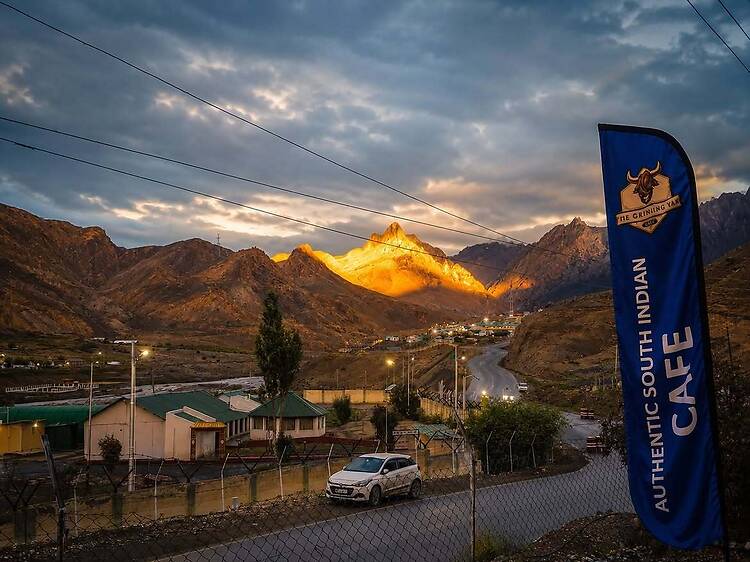
When I was planning my road journey to Ladakh, I wasn’t totally sure how much time I wanted to devote to Drass. Naturally, it was on the itinerary, but at first, I considered it more of a stopover than a separate location to explore. I had second thoughts after actually travelling through the valley.
Drass does not have the type of sightseeing list that makes a place appear crowded on paper. Instead, it has a significant relationship to the history of the Kargil War and a a changing landscape as the road passes through it. This combination, in my opinion, made coming here worthwhile.
The road into Drass was part of the experience
I found myself staring out the car window much more than I had anticipated during the approach to Drass. The terrain alternates between rocky slopes, lush areas, and the Suru River flowing through the valley as the mountains progressively grow larger.
It was more than just a single breathtaking viewpoint. Around me, the landscape was constantly shifting, occasionally widening into a broad valley and then contracting once more between the mountains. That was likely the first sign that Drass was worth more than a fleeting roadside snapshot.
Drass has a history that changes how you see the landscape
Drass is inextricably linked to the Kargil War. The village and surrounding mountains were involved in the 1999 battle, and if that history is considered, the seemingly distant and unspoiled scenery takes on a new significance.
For this reason, I didn’t want to approach the Kargil War Memorial at Drass like a typical tourist destination. It was easier to comprehend the war’s topography when standing there and gazing at the nearby peaks. Tololing and Tiger Hill are particularly popular in the area. Photographs just cannot capture the perspective that comes from seeing these mountains up close.
The Kargil War Memorial was the Drass stop I remember most
The memorial, near Drass, is a major draw for many tourists. A serene environment is created by the well-kept lawns, memorial walls, and views of the neighbouring mountains.
I looked at the mountains for longer than I expected. The scenery felt different from how it had appeared from the road just moments before, knowing that those slopes had been crucial to the war. I also realised why Drass is more than just a convenient stopover between Srinagar and Kargil.
I didn’t need a packed itinerary in Drass
One thing I liked about Drass was that there wasn’t pressure to fill every hour. The town is small, and the attraction is largely in its setting. A walk around the settlement, time beside the river and a drive through the surrounding valley can be enough. If the weather is clear, simply finding a place to stop and look at the mountains becomes an activity in itself.
For travellers staying in hotels in Kargil, Drass can also work as a day excursion, since Kargil is roughly 60 kilometres away. But I personally liked the idea of treating Drass as a proper halt rather than rushing through it and returning to Kargil the same day.
So, is Drass worth adding to a Ladakh road trip?
Yes, in my opinion, especially if the route already goes via Kargil. While spending a few hours or an overnight stay in Drass feels quite different from just driving by, it doesn’t take several days to create an effect.
Additionally, it gives a Ladakh itinerary that otherwise is dominated by mountain passes, monasteries, and striking scenery some historical depth. The halt is made more significant by the Kargil War Memorial, the vistas of Tololing and Tiger Hill, and the larger Suru Valley.
Travellers who prefer a more developed base can stay in hotels in Kargil and visit Drass from there. But those with enough time should consider staying overnight in Drass itself, especially if they want to experience the valley in the quieter morning and evening hours.
Final thoughts
Because Drass was on the path, I assumed it might be one of those significant locations. I felt that it had earned a spot in the voyage when I left. Although the mountains are undoubtedly the first thing that comes to mind, they don’t tell the complete narrative. Drass combines an amazing environment with a very recent period of Indian history, and experiencing both in one location lends the trip a significance I hadn’t expected.
Therefore, I wouldn’t treat Drass as just another name on the itinerary if it is already on the itinerary. Take your time, explore the memorial, gaze up at the mountains, and spend some time in the valley. Seeing it correctly is worthwhile.





Leave a Reply